
Full pipe replacement
Trenchless Pipe Bursting
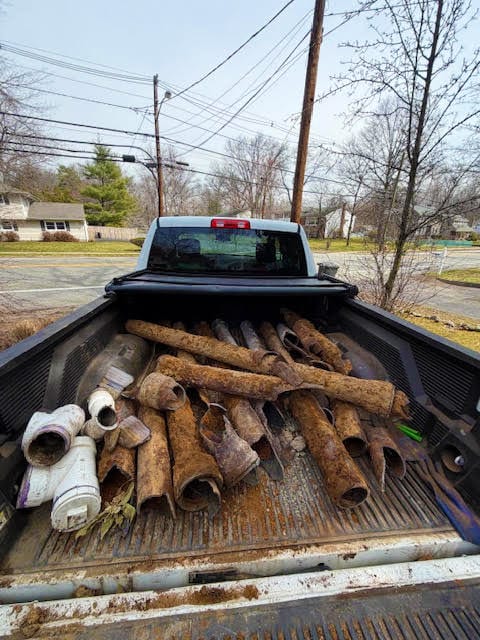
Pipe bursting replaces a failing pipe with a completely new one, pulled through the path of the old line while the old pipe is broken apart around it. You get new pipe without a trench along the whole run.
01Trenchless & excavation
The setup is two pits, one at each end of the section being replaced. A cable or rods are run through the old pipe from one pit to the other. A cone-shaped bursting head is attached, with the new pipe connected behind it. As the head is pulled through, it fractures the old pipe and pushes the pieces outward into the soil, and the new pipe follows into the space it leaves.
The new pipe is commonly a continuous length of high-density polyethylene with fused joints, so there are no joints along the run for roots to enter. Depending on the conditions, the new pipe can be the same size as the old one or slightly larger.
Bursting works well on clay, cast iron and other brittle pipe, including pipe that is cracked, offset or partly collapsed. It is less suited to lines that run very close to other buried utilities or a foundation, since the old pipe is pushed outward, and to lines with a sag that needs regrading. Those conditions are why we inspect and locate before recommending it.
02When to call
Signs it's time
- 01Sewer pipe that is broken, offset or partly collapsed
- 02Clay or cast iron laterals with heavy root damage
- 03A line too damaged for relining
- 04A run under a driveway, walkway or landscaping
- 05A line that would benefit from being slightly larger
- 06An old water service line that needs full replacement
03How we handle it
- 1
Inspect, locate and check surroundings
We camera the line, mark its path and depth, and check for nearby utilities and structures that affect whether bursting is safe.
- 2
Dig the access pits
We open a launch pit and a receiving pit at the ends of the section, sized for the equipment and the connections.
- 3
Burst and pull
The bursting head is pulled through the old line, breaking it apart while the new pipe follows behind.
- 4
Connect, test and backfill
We connect the new pipe at each end, test it, run a camera through, and backfill the pits.
04What's included
The scope, in plain terms
On the truck for this
- Trenchless pipe bursting
- Sewer camera inspection
- Pipe locating equipment
- Camera inspection and line locating
- Assessment of nearby utilities and structures
- Launch and receiving pit excavation
- Full sewer lateral replacement by bursting
- Water service line replacement by bursting
- Connections at the house and street end
- Testing and camera verification
- Backfill of access pits
05Questions
What people ask about trenchless pipe bursting
How is bursting different from relining?
Bursting destroys the old pipe and replaces it with new pipe. Relining keeps the old pipe and builds a new one inside it. Bursting handles more severe damage. Relining needs less excavation but requires a host pipe that holds its shape.
Can bursting damage things near the pipe?
It can if the line runs very close to other utilities or a structure, because the old pipe is pushed outward as it breaks. That is why we locate the line and check what is around it first. If the risk is too high, we recommend another method.
Do I still need to dig?
Yes, but much less. Typically one pit at each end of the section being replaced, instead of a trench along the whole length.
Related work
Trenchless Pipe Bursting in these towns
- Bloomfield
- Boonton
- Caldwell
- Cedar Grove
- Clifton
- Fairfield
- Franklin Lakes
- Hackensack
- Lincoln Park
- Little Falls
- Livingston
- Madison
- Midland Park
- Montclair
- Montville
- Morristown
- Mountain Lakes
- North Caldwell & West Caldwell
- Nutley
- Oakland
- Paramus
- Parsippany
- Pequannock
- Pompton Plains
- Ridgewood
- South Orange
- Totowa
- Wayne
- West Orange
- Wyckoff
Request service
Tell us what's going on.
We'll get back to you to set a time. Anything urgent, call instead: (973) 513-7751.