Pipe inside a pipe
Trenchless Pipe Relining
Relining builds a new, seamless pipe inside your existing one. It seals cracks and open joints, keeps roots out, and usually needs little or no excavation.
01Trenchless & excavation
Relining is often called cured-in-place pipe. A flexible liner is saturated with resin, inserted into the old pipe, and pressed against the walls. The resin then cures and hardens, leaving a rigid new pipe with no joints along the lined section. The old pipe stays in the ground as the outer shell.
Preparation is most of the job. The line has to be cleaned down to the pipe wall, usually with high-pressure jetting, and roots and scale have to be removed so the liner bonds and sits smoothly. A camera inspection before and after confirms the pipe was ready and the liner cured properly. Where branch lines join the section, the openings are reinstated from inside after curing.
Relining fits pipe that is cracked, leaking at the joints, corroded or letting roots in, but still holds its shape. It does not suit a pipe that has collapsed flat or has a sag holding water, since the liner follows the existing pipe. The finished pipe is slightly smaller inside than the original, though the smooth interior flows well.
02When to call
Signs it's time
- 01Roots entering through clay or cast iron joints
- 02Cracks or pinhole corrosion seen on camera
- 03Joints leaking or slightly separated
- 04A line under a slab, driveway or finished landscape
- 05A pipe that holds its shape but keeps failing
- 06A line you want to rehabilitate instead of replace
03How we handle it
- 1
Inspect and measure
We camera the line to confirm it holds its shape, measure the length to be lined, and note every branch connection.
- 2
Clean to the wall
We jet the line and remove roots and scale so the liner can bond to clean pipe.
- 3
Install and cure the liner
The resin-saturated liner is inserted, pressed against the walls and cured in place.
- 4
Reopen branches and verify
We reinstate branch connections from inside, then run a camera through to confirm a smooth, sealed finish.
04What's included
The scope, in plain terms
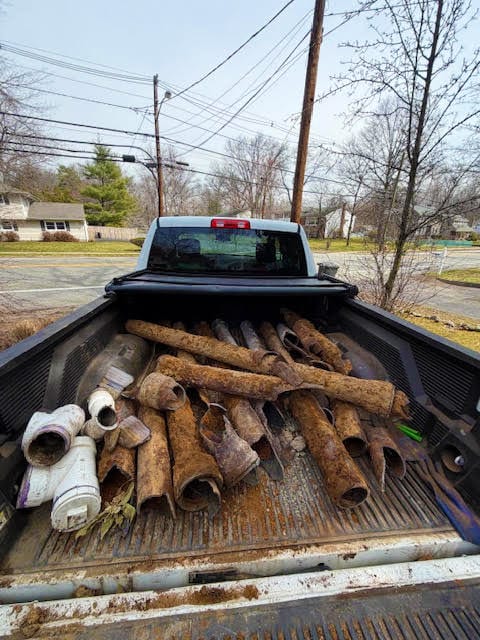
On the truck for this
- Pipe relining
- High-pressure water jetting
- Sewer camera inspection
- Camera inspection to confirm relining eligibility
- Line cleaning and root removal before lining
- Relining of sewer and drain lines
- Sealing of cracks, open joints and corrosion
- Reinstating branch connections from inside
- Post-lining camera verification
- Flow testing after the repair
05Questions
What people ask about trenchless pipe relining
Will relining shrink my pipe?
Slightly. The liner adds a thin wall inside the old pipe. In most residential lines, the smoother surface offsets much of that, and the line flows well.
Can every pipe be relined?
No. The old pipe has to hold its shape. A pipe that is crushed, collapsed or has a significant sag needs bursting or excavation instead. The camera inspection decides it.
Will roots come back after relining?
Roots get into pipe through joints and cracks. A properly installed liner has no joints along the lined section, which takes away the opening they use.
Related work
Trenchless Pipe Relining in these towns
- Bloomfield
- Boonton
- Caldwell
- Cedar Grove
- Clifton
- Fairfield
- Franklin Lakes
- Hackensack
- Lincoln Park
- Little Falls
- Livingston
- Madison
- Midland Park
- Montclair
- Montville
- Morristown
- Mountain Lakes
- North Caldwell & West Caldwell
- Nutley
- Oakland
- Paramus
- Parsippany
- Pequannock
- Pompton Plains
- Ridgewood
- South Orange
- Totowa
- Wayne
- West Orange
- Wyckoff
Request service
Tell us what's going on.
We'll get back to you to set a time. Anything urgent, call instead: (973) 513-7751.